


We have already talked about the “base layer” and the importance of wearing a shirt that keeps you dry by transporting sweat to the outside to evaporate quickly (see https://bit.ly/2LOKaEZ).
But what are the parameters used to quantify how well a fabric performs these tasks?
- RET
- RCT
- BUFFERING INDEX (Ia,r; Ir)
- DRYING TIME (Δt)
Don’t worry, it sounds complicated but I promise we won’t use any math formulas. First of all, it’s important to define the word “comfort” and how it relates to a garment’s performance.
COMFORT
Often without realizing it, when we open our closet our hand always reaches for our favorite shirt — this happens because we feel particularly good wearing it. To define “textile comfort,” which means the level of well-being offered by a garment and the pleasant feeling perceived when wearing it, we must exclude factors related to fashion or memories.
Comfort is very important both to avoid skin irritations and to prevent thermal stress caused by overheating or excessive cooling, which leads to discomfort, decreased physical performance, reduced attention, and premature fatigue.
To measure comfort scientifically, lab tests are conducted following international standards that measure the parameters listed above, assigning quantifiable values to compare garments made with different fabrics and materials.
By combining test results with other factors such as surface fuzziness, fabric friction against the skin, and the fabric’s ability to adapt to body shapes, we obtain a scientific definition of comfort level.
RET
RET stands for “Resistance to Evaporative Transfer” — it measures the breathability of a fabric or its ability to transport moisture outward to evaporate.
The term “breathability” is nowadays widely used — and often misused — especially in advertising for sportswear made from various materials that are often hardly breathable at all.
The table below (not included here) was created for all types of garments, including outer jackets that naturally have higher RET values. Therefore, when evaluating a base layer, the RET values must always be below 6.
Many low-quality products marketed as breathable are in fact not.
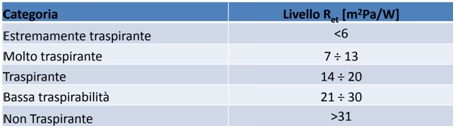
FORCETEK only labels a garment è “Breathable” if it has an RET value below 6.
An ideal RET for a summer shirt must be less than 3, while a long-sleeve winter base layer should have an RET below 4. Otherwise, the base layer will not efficiently transfer sweat outward.
Be careful: just reading “breathable” does not mean the product truly is!
RCT
RCT stands for “Resistance to Conductive Heat Transfer” and indicates the thermal insulation of a garment.
The higher the RCT, the more the garment retains body heat and acts as insulation. Garments with low RCT tend to release heat more easily.
For example, a sweater should have a high RCT to keep the body warm, while a summer shirt should have a low RCT to dissipate heat.
Below is an example to better understand the effect of RCT on our physique :
For example, a sweater should have a high RCT to keep the body warm, while a summer shirt should have a low RCT to dissipate heat.
Think of a copper wire (good heat conductor): a garment with low RCT acts like copper, transferring body heat outward.
A garment with high RCT acts like plastic, insulating and retaining heat.
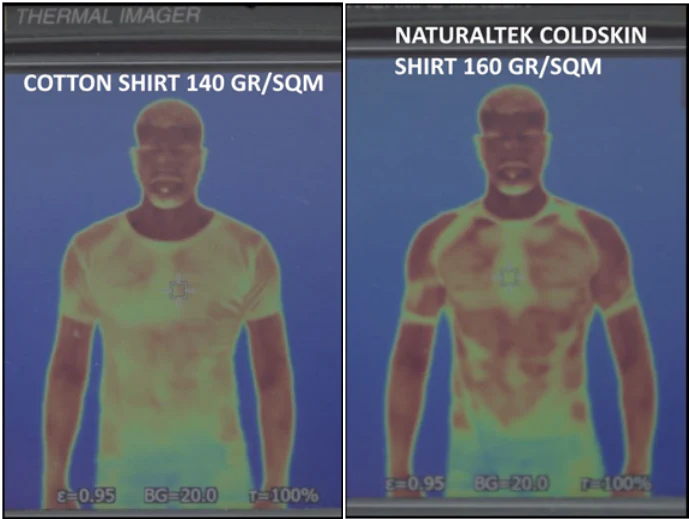
Images compare a Naturaltek ColdSkin shirt and a standard cotton shirt.
The cotton shirt has a higher RCT, retains more heat, and is more insulating.
The ColdSkin shirt has very low RCT, lets heat pass through, transferring it outward, making it great for summer or hot climates. transfers it to the outside, making it an excellent shirt to use in summer or in countries with hot climates.
BUFFERING INDEX (Ia,r; Ir)
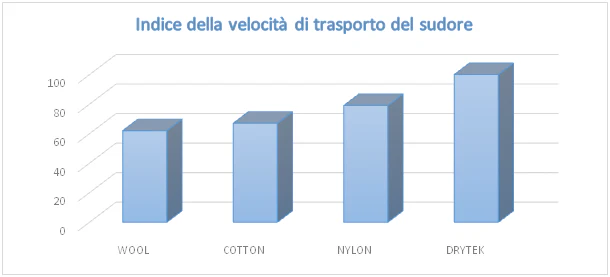
This index measures a garment’s ability to manage sudden sweating caused by increased physical activity. It measures both sweat evaporated (transported outside) and sweat absorbed by the fabric.
A garment that quickly transports sweat outward without soaking itself provides better comfort.
For example, cotton absorbs a lot of moisture and releases it slowly, making it unsuitable for sports.
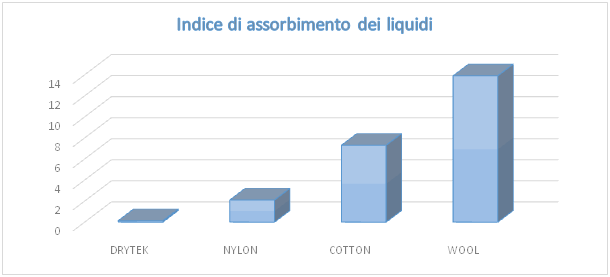
Drytek polypropylene absorbs only 0.13% of its weight in liquids and evaporates it very fast, keeping skin drier. Unlike other materials, Drytek maintains body temperature and prevents chills after exercise, even if the shirt is damp.
DRYING TIME (Δt)
Drying time is the simplest variable but not the least important.
A garment that dries faster offers superior comfort and can make the difference between returning home happy or chilled.
As mentioned, fibers with lower water absorption dry faster — Drytek polypropylene tops the list as it absorbs less water among fibers commonly used in technical garments.
OTHER IMPORTANT FACTORS FOR COMFORT
Surface fuzziness: Less fuzziness means better appearance, less pilling (those annoying little balls on shirts), and a nicer feel against the skin.
Friction force: Less friction means less rubbing and lower risk of skin irritation or discomfort.
Too stiff fabric fits poorly, restricts movement, and causes discomfort.
CONCLUSIONS
Often when buying a garment, we overlook the materials and technologies used in its production, but they are essential to improve body comfort and performance.
By understanding fundamental parameters defining comfort, we want to highlight the details that make the difference between a normal garment and a technical one that, once worn, transforms those numerical values into real benefits.
The numerous tests we conduct daily ensure top performance for military and law enforcement personnel protecting us every day, and for all civilians who trust our philosophy.
A garment is not just a piece of fabric — it is a concentration of study and technology!